
Last updated September 20, 2026
Full 25-point door and opener safety check with every visit - springs, cables, rollers, tracks, and your LiftMaster or Chamberlain opener included
You get a price before we start. It does not change when the truck arrives.
 Before
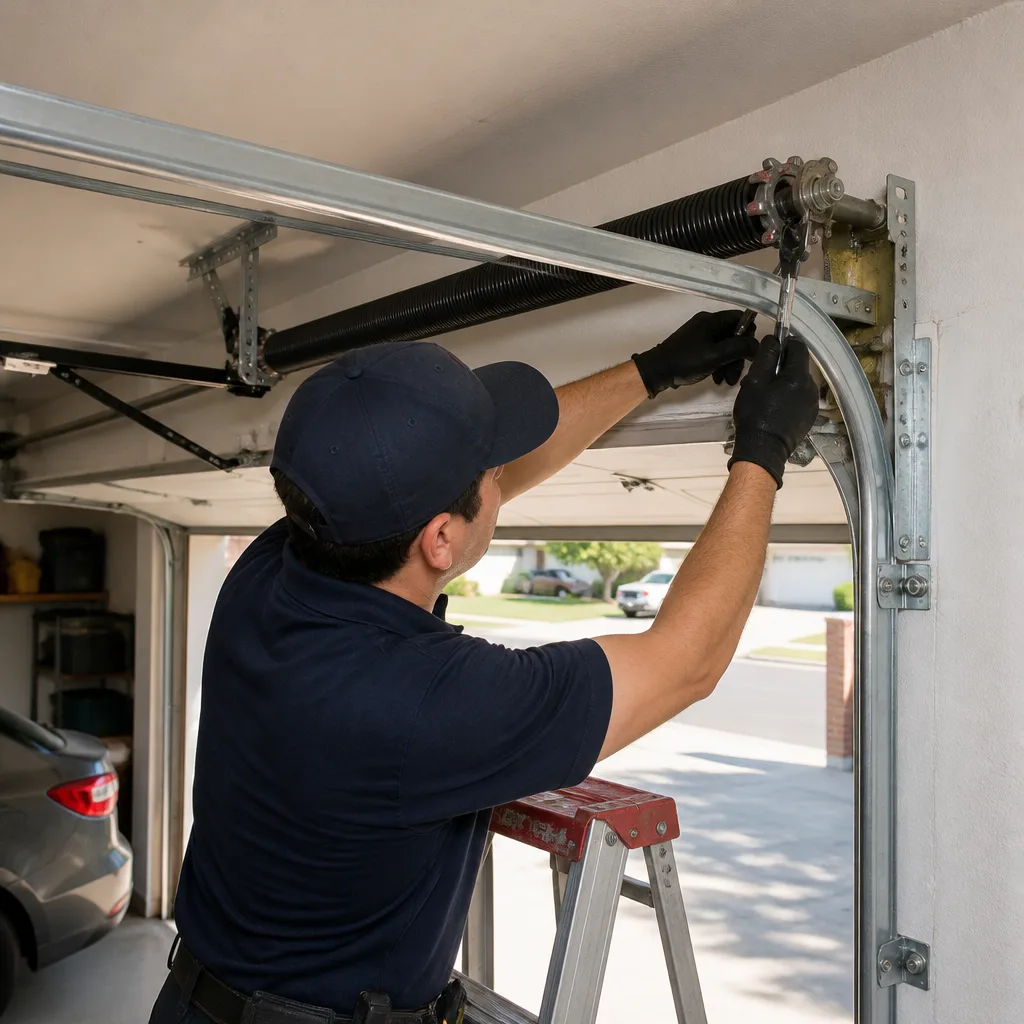 After
After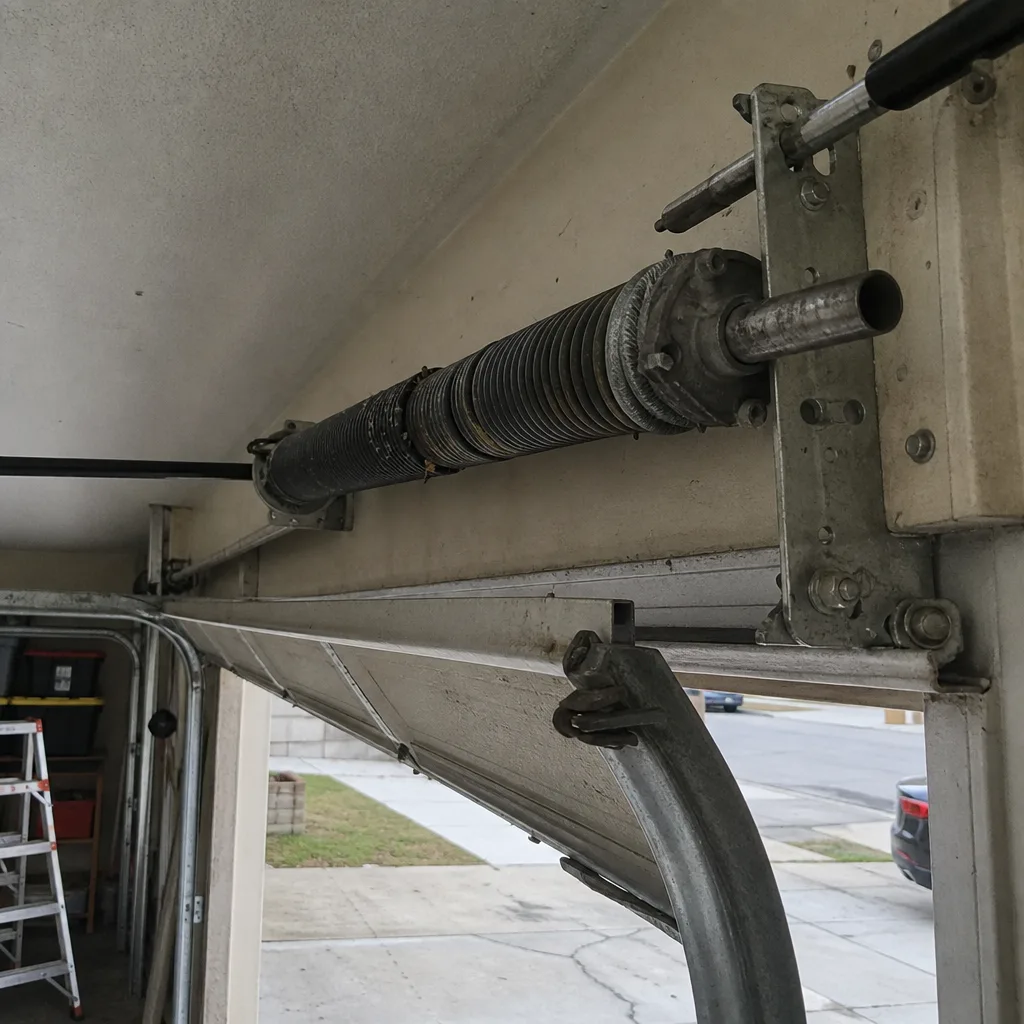 Before
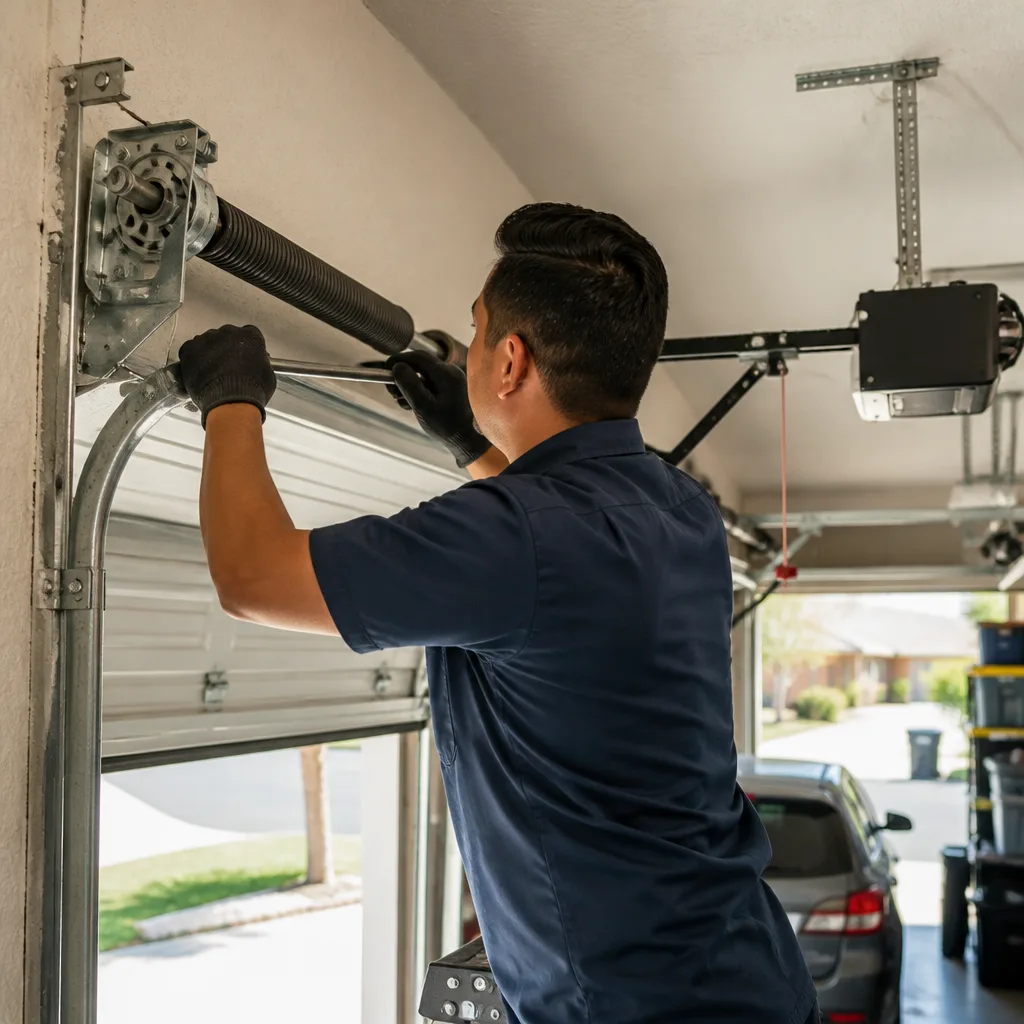 After
After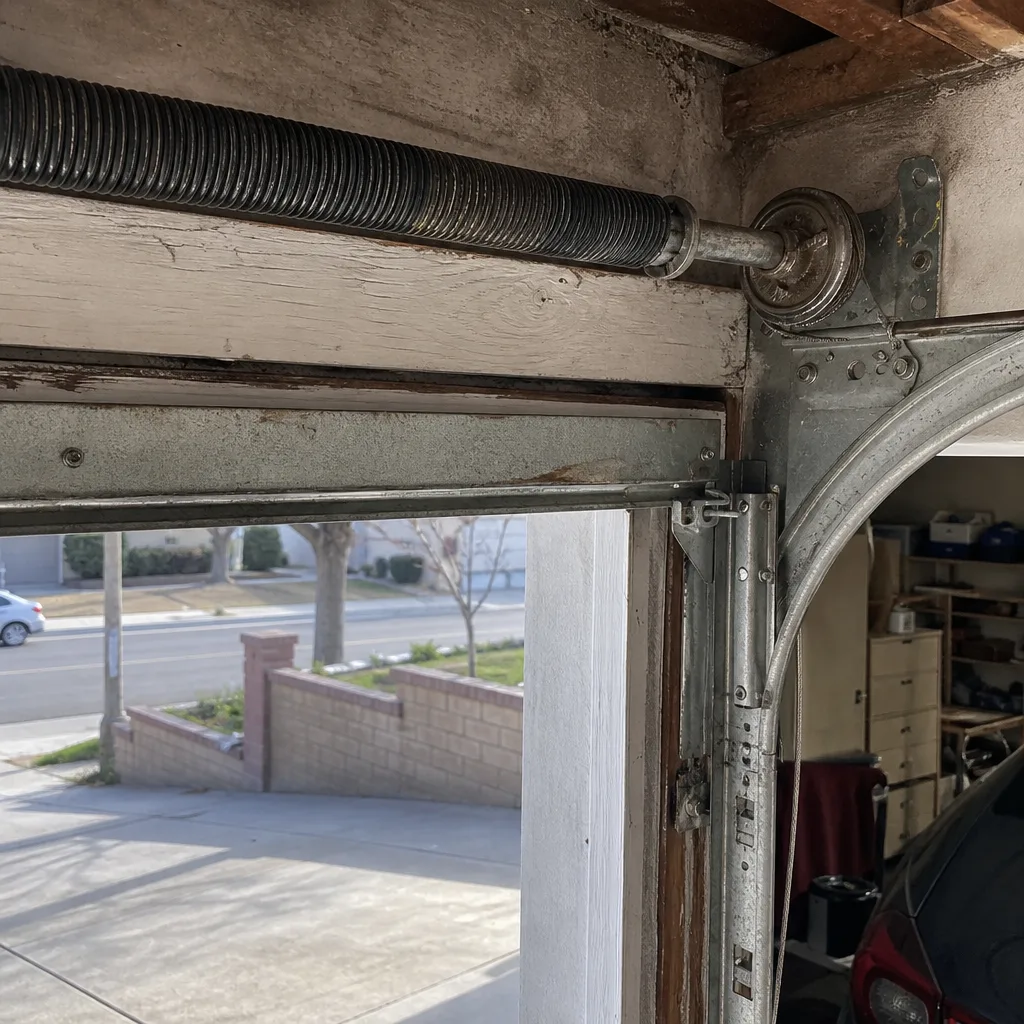 Before
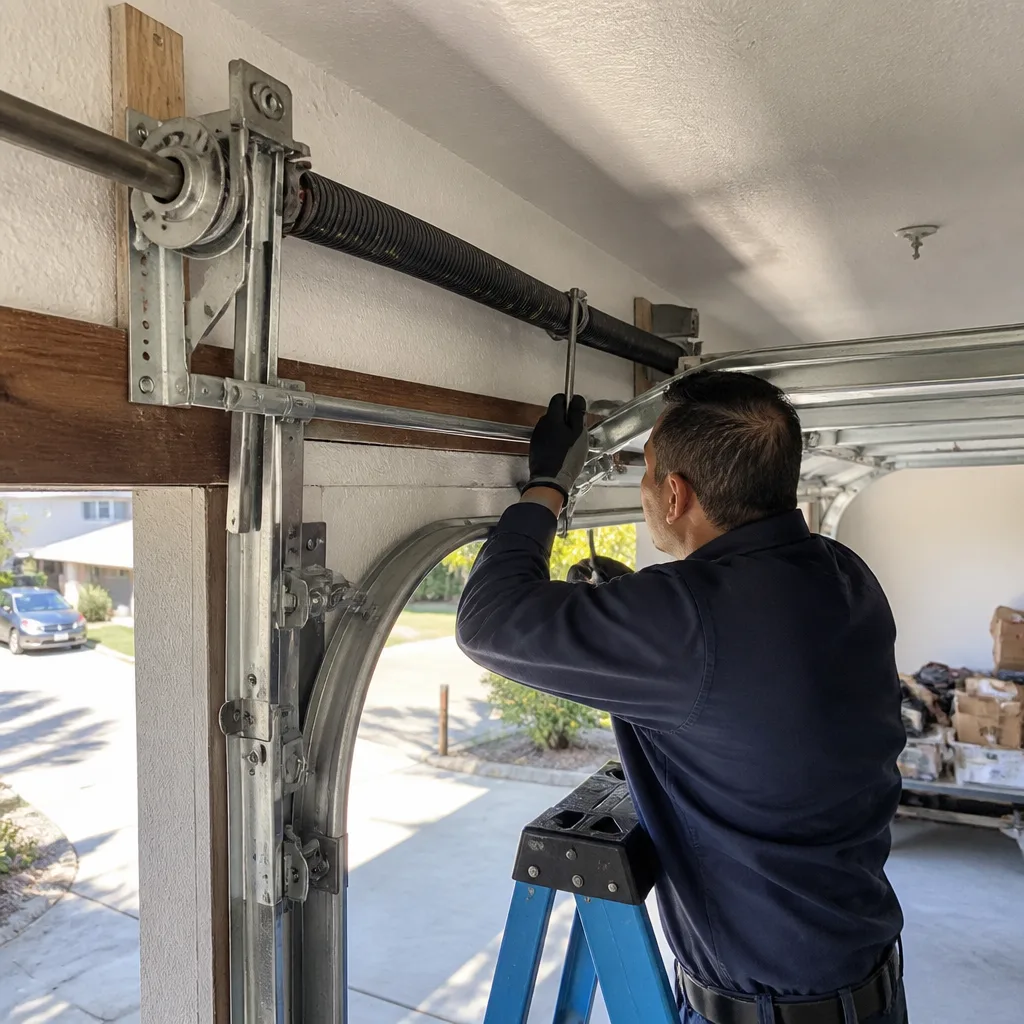 After
AfterThe Complete Guide to Garage Door in Rancho Cucamonga
The Rancho Cucamonga municipal code references garage doors in three separate sections: zoning, building, and property maintenance. Most homeowners discover this only after scheduling an installation that has to be undone. This guide - alongside our DIY vs Professional Garage Door: The Rancho Cucamonga Homeowner’s Decision Guide - walks through every decision a homeowner faces, from spring ratings sized for 105-degree summers to HOA architectural restrictions in Terra Vista, Victoria, and Etiwanda Estates, and maps each choice to the specific conditions that govern it here in Rancho Cucamonga.
Quick Answer
A garage door in Rancho Cucamonga is not a generic installation. The Inland Empire’s sustained heat cycles, predominant stucco tract-home construction from the 1980s through 2000s, and HOA covenants in master-planned communities create a specific set of decisions: heat-rated torsion springs, wind-load considerations on north-facing slopes, panel styles subject to architectural review, and insulation values sized against local utility rate data rather than national averages. This guide covers all of it, section by section.
Table of Contents
- Torsion Springs and Rancho Cucamonga Heat: Why Online Specs Fail Here
- HOA Architectural Guidelines: Terra Vista, Victoria, and Etiwanda Estates
- Sectional vs. One-Piece Tilt-Up Doors in RC’s Tract Home Era
- Reading R-Value Against Local Utility Data, Not National Averages
- Permit Thresholds: How Rancho Cucamonga Differs from Ontario and Fontana
- Maintenance Schedule for Rancho Cucamonga’s Climate
- Choosing Between Major Brands: What Actually Matters Locally
- Common Mistakes to Avoid
- When to Call a Professional
- Frequently Asked Questions
- The Bottom Line
BeforeAfterTorsion Springs and Rancho Cucamonga Heat: Why Online Specs Fail Here
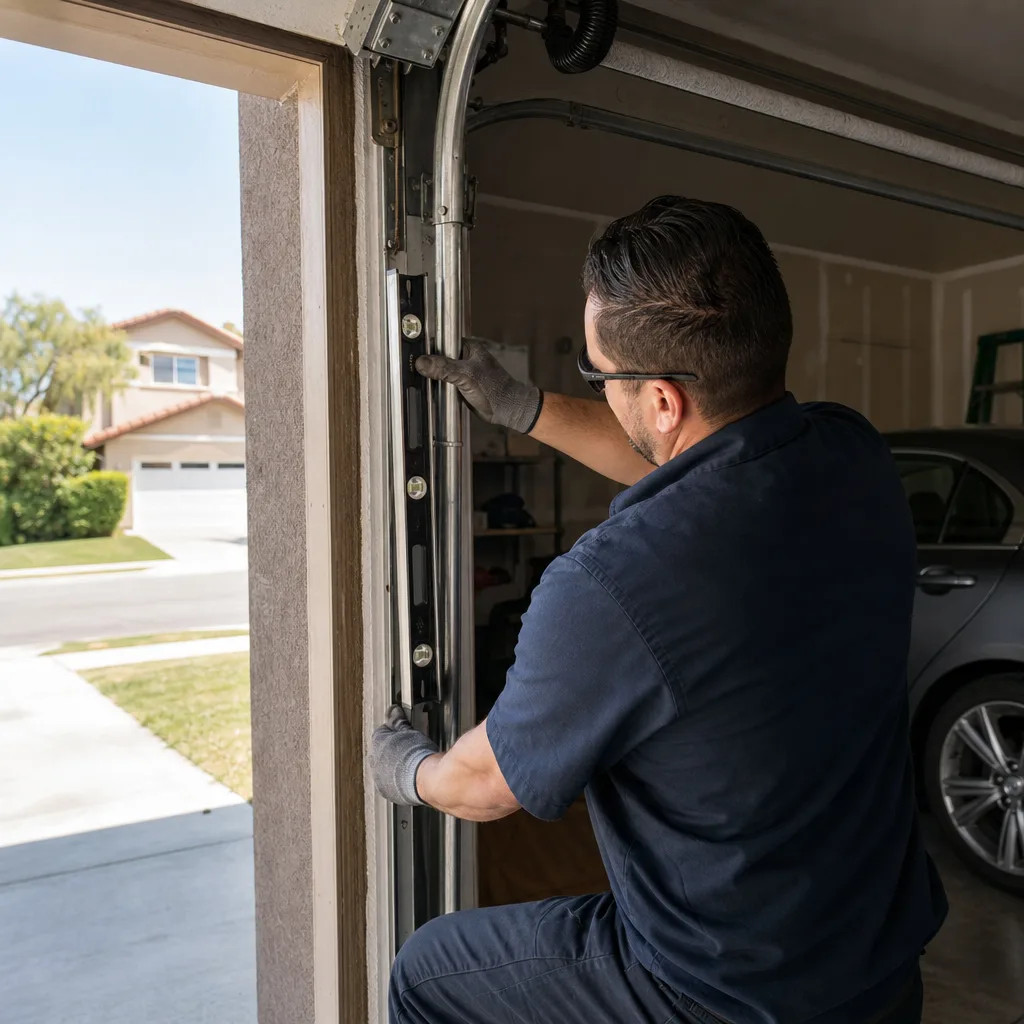
Torsion springs are rated by wire diameter, coil count, and cycle life. Most online retailers ship springs calibrated for a 10,000-cycle lifespan under moderate temperatures. That spec assumes a climate where the garage interior stays below 85 degrees. In Rancho Cucamonga, where July and August temperatures routinely exceed 100 degrees and garage interiors can hit 120 or higher, those same springs fatigue faster.
Here’s the mechanism. Torsion springs are made of oil-tempered or galvanized steel wire. Heat accelerates the relaxation of the steel’s molecular structure, which is a technical way of saying the spring loses torsional force incrementally. A spring rated for 10,000 cycles in a temperate climate may deliver 6,000 to 7,500 cycles in an uninsulated Rancho Cucamonga garage. That is not a defect. It is physics.
What this means practically:
- Spring gauge matters more here. A 0.225-inch wire diameter spring that works in coastal climates often underperforms in Rancho Cucamonga. The correct spec is usually a step up in wire gauge, which raises the cycle life under sustained heat.
- Ask for the spring type. Galvanized springs hold up marginally better under temperature swings than plain oil-tempered ones. The difference is not dramatic, but over a decade in an inland climate it shows.
- Beware of “standard” replacement springs. A technician who carries one or two spring gauges on the truck and matches by door weight alone is guessing. A correct install requires measuring wire diameter, coil length, inside diameter, and door height, then calculating cycles against your specific garage’s thermal profile.
We have seen this in practice across Garage Door Repair in Rancho Cucamonga calls: a spring installed two years ago snapped in March, and the homeowner assumed a defect. The real story is that the spring was under-spec’d for the thermal load. When we replace it, the new spring is documented with a photo of the failed component, its measurements, and the replacement’s rated cycle count. That’s Clause 4 of The Haven Standard, and it’s the reason we photograph the failed part before quoting a replacement.
HOA Architectural Guidelines: Terra Vista, Victoria, and Etiwanda Estates
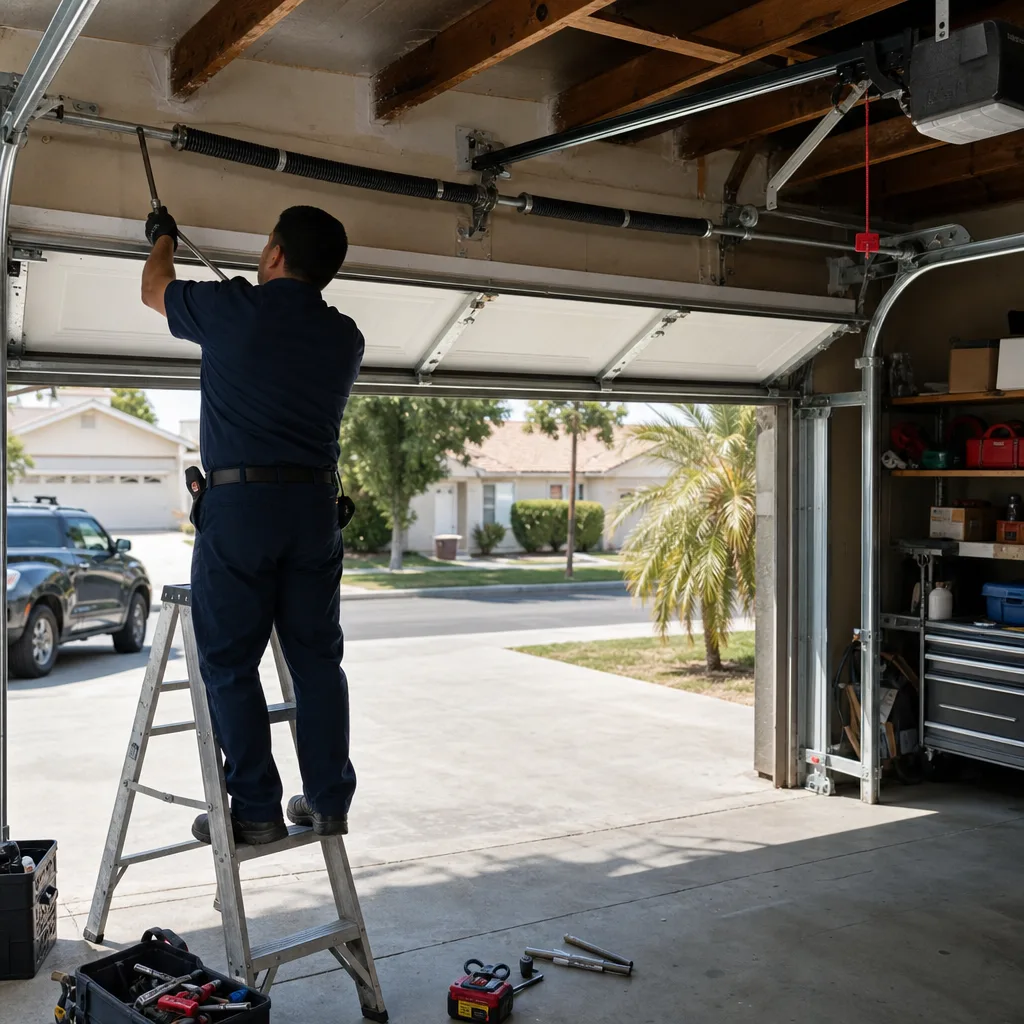
Rancho Cucamonga is a master-planned city. That means the majority of single-family homes sit inside HOA-governed communities, and garage doors are one of the most commonly flagged items in architectural review. What gets flagged depends on the community.
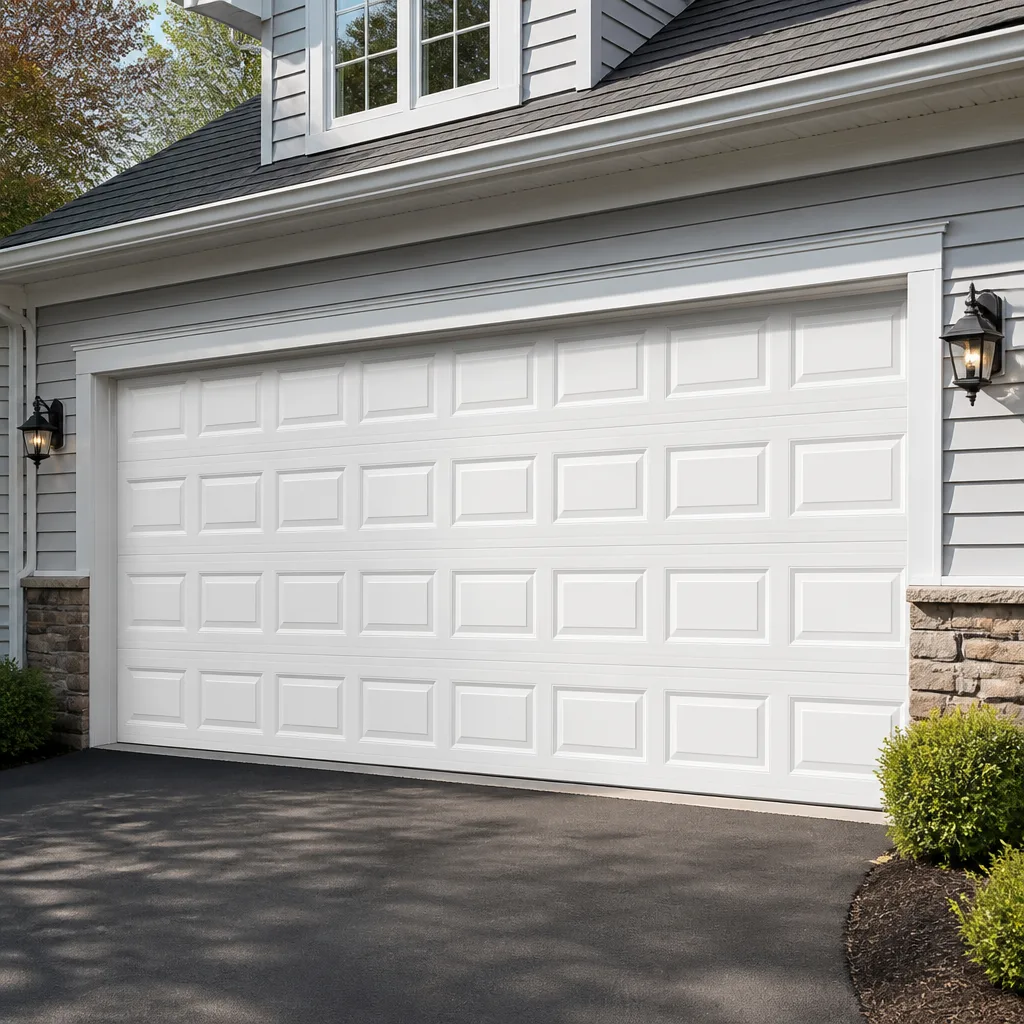
Terra Vista is governed by a planned development overlay that restricts garage door finish colors to a narrow palette matching the original tract elevations. Panel styles are generally limited to raised-panel or flush designs; carriage-house overlays are explicitly excluded in most sub-associations. Window placement, if allowed at all, is typically restricted to the top section only.
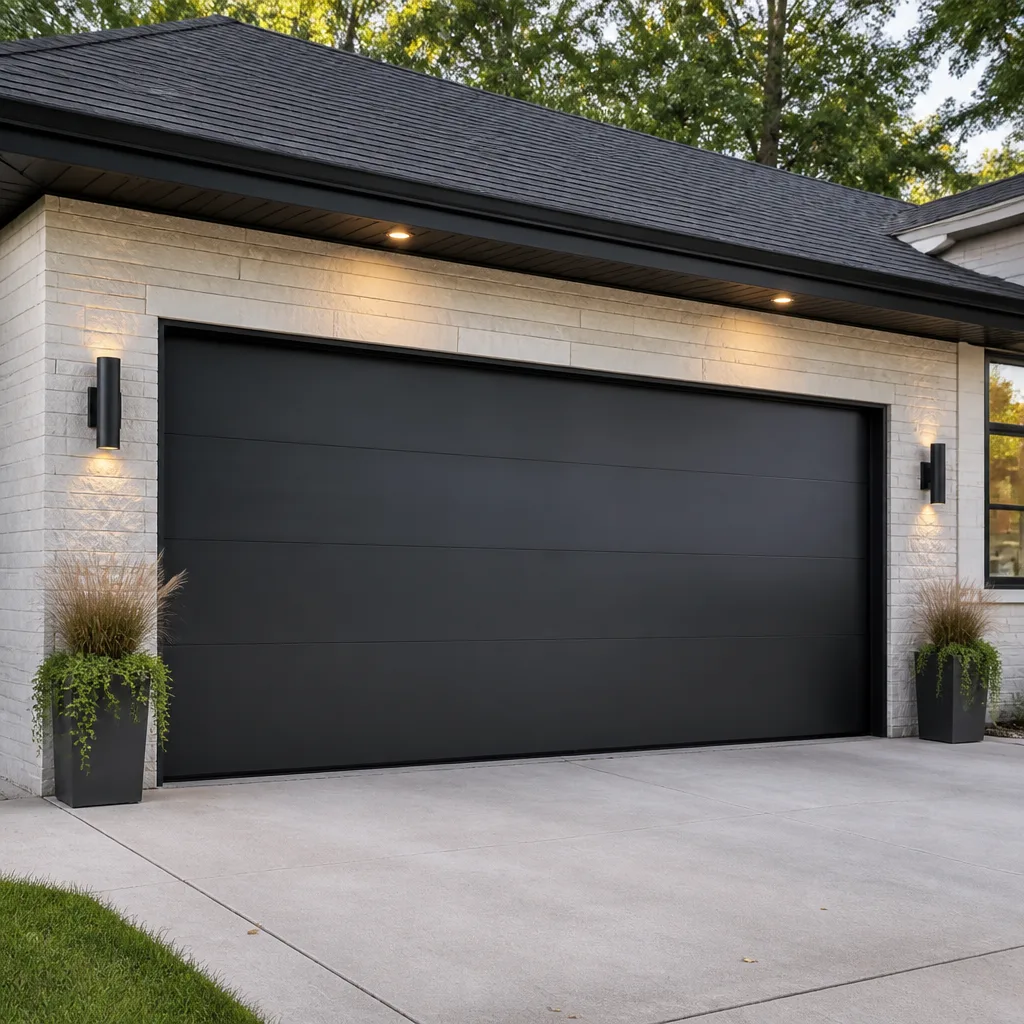
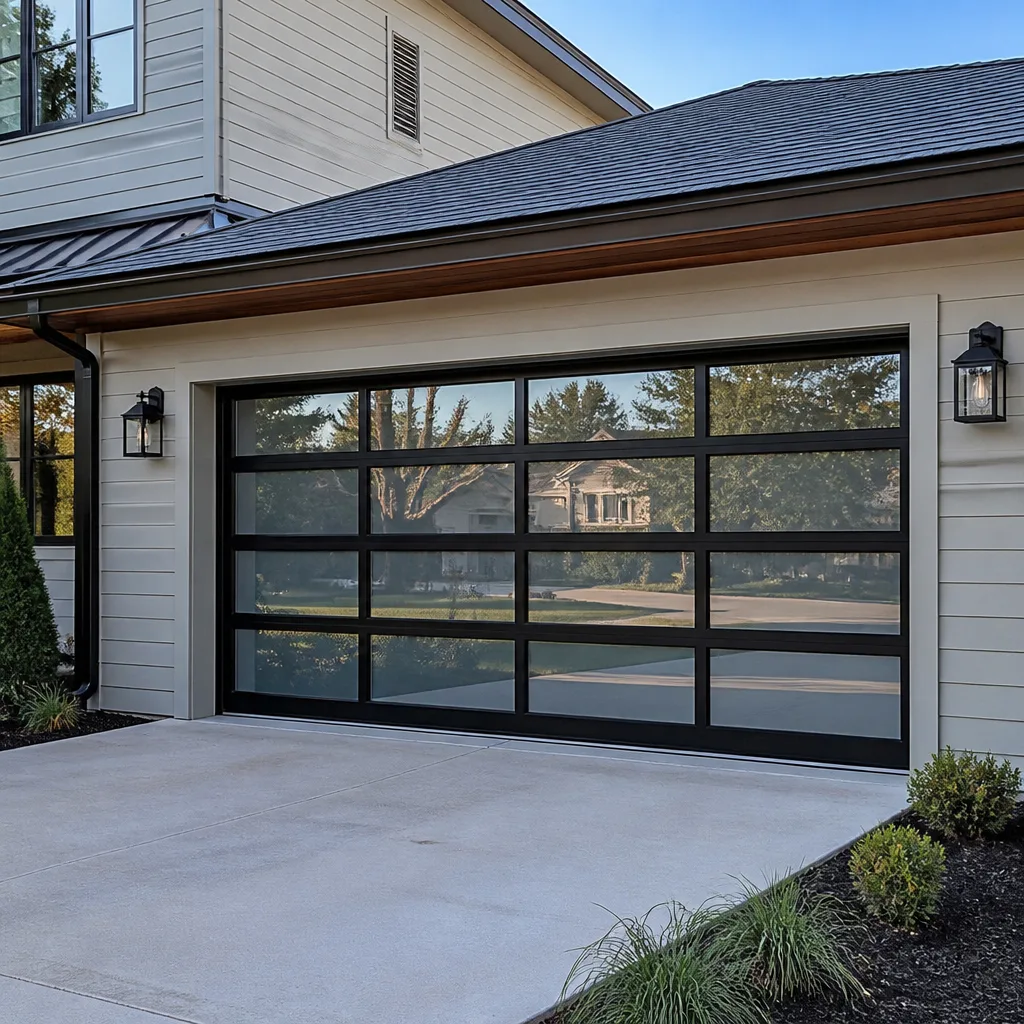
Victoria - the neighborhoods north of the 210 around Victoria Gardens - has its own architectural committee that enforces consistency across streetscapes. In practice, this means if your immediate street was built with white raised-panel steel doors, the committee will likely deny a full-view aluminum door with a black frame, even if a similar door exists three blocks away. They review by tract, not by city.
Etiwanda Estates, in the northeast, skews toward larger lots and a specific exterior style that often includes stained-wood or wood-look garage doors. Modifying from that look requires a design review submittal with samples. We have seen homeowners order a new Amarr or Clopay door online, install it, and then receive a correction notice requiring either removal or a retroactive review that they never filed. The door comes back down.
Before ordering anything, do the following:
- Pull your HOA’s CC&Rs and look for the architectural review section, specifically the subsection on garage doors or exterior elevations.
- Check whether a pre-approved style list exists. Many Rancho Cucamonga associations maintain a list of approved door styles by tract number.
- If the door face is visible from the street, assume it requires review. This includes repainting the same door a different color.
- Submit samples or manufacturer spec sheets. A Home Depot printout is not sufficient for most architectural committees.
- Wait for written approval. Verbal approval from a management company employee is not binding.
In our experience, the single most common mistake in Rancho Cucamonga is treating the HOA review as optional and the second most common is assuming the city permits the HOA to restrict safety features. They cannot. An HOA can restrict finish, color, and panel profile. They cannot prevent you from installing a code-compliant door. They also cannot require a specific opener brand. Those are safety and access issues, and the city’s building code governs them.
Sectional vs. One-Piece Tilt-Up Doors in RC’s Tract Home Era
Rancho Cucamonga’s housing stock falls into recognizable construction eras. The city grew in three waves: the 1970s and early 1980s subdivisions south of the 10, the 1980s and 1990s tract expansion between the 10 and the 210, and the 2000s communities north of the 210 toward the Etiwanda foothills and the Victoria master plan.
In the first wave, the door was frequently a one-piece tilt-up, also called a California tilt-up or slab door. These doors pivot on side hinges and lift outward before sliding back into the garage on horizontal tracks. They are simple, and in the 1970s they were cheap. But they have a distinct weakness in modern terms: they require the car to be parked a full door-height away before the door can be opened. A tilt-up door physically swings out before retracting.
The second and third waves standardized on sectional doors: four or five horizontal panels that roll straight up on vertical tracks and tuck under the ceiling. Sectional doors allow a car to pull close to the door, which matters in Rancho Cucamonga tract homes where driveways are often exactly one car length plus a few feet.
What this means today:
- If you own a 1970s home south of the 10 with the original tilt-up door, converting to a sectional door typically requires new tracks, new hardware, and often a new header mounting. This is a real installation project, not a panel swap.
- The maximum door width on older single-car garages in central Rancho Cucamonga is frequently 8 feet, not the 9-foot width common in newer tracts. A sectional door conversion on an 8-foot opening is straightforward, but ordering a 9-foot door by mistake is a costly error.
- Attached garages in the 1980s and 1990s tracts often have ceiling heights between 8 and 9 feet, which limits high-lift track conversions. If you are planning a car lift, measure the ceiling before pricing the door.
For most Rancho Cucamonga homeowners, the answer is clear: replace the tilt-up with a properly installed sectional, and if your garage is from the second or third wave, you are already there. Garage Door Installation in Rancho Cucamonga includes measuring the existing opening, verifying header condition, and quoting the full job in writing before any work starts.
Reading R-Value Against Local Utility Data, Not National Averages
Insulated garage doors are marketed by R-value, which measures thermal resistance. The national buying guides frame R-value as a comfort metric. In Rancho Cucamonga, the calculation is different because Southern California Edison’s tiered rate structure punishes heat gain differently than a flat-rate utility.
Here is the local reality. An attached garage in Rancho Cucamonga acts as a thermal buffer between the outside air and your conditioned living space. In summer, an uninsulated steel door absorbs direct afternoon sun on west-facing elevations and radiates that heat into the garage. The garage air then transfers heat through the shared wall into the house, forcing the HVAC to cycle longer. For a two-story home where bedrooms sit directly above the garage, the effect is pronounced: the floor stays warm into the night.
The local utility angle:
- SCE’s summer on-peak rates run from 4 PM to 9 PM, which is exactly when the garage is hottest and the AC is working hardest. An insulated door reduces the thermal load during this window.
- East-facing doors catch morning sun; west-facing doors catch the punishing late afternoon sun. The R-value decision should factor in elevation. A west-facing door on an attached garage in northern Rancho Cucamonga is a higher-insulation priority than a north-facing door on a detached garage.
- Polystyrene insulation (typically R-6 to R-9) is cost-effective for most Rancho Cucamonga garages. Polyurethane (R-12 to R-18) makes measurable sense when the garage shares a wall with living space and the door is west-facing.
The honest math is that an insulated door will not transform an uninsulated garage into a conditioned room. The garage walls and ceiling still leak thermal energy. But the door is the largest single surface on the elevation, and it is the surface that faces the afternoon sun. If you are already replacing a door, stepping up from uninsulated to R-9 polystyrene adds about $200 to $400 on a standard double door. That is the best value insulation decision available on the project.
Permit Thresholds: How Rancho Cucamonga Differs from Ontario and Fontana
Garage door replacement is generally not a permitted project in California when the door goes into an existing opening with no structural work, though Garage Door Permits, Codes & Inspections in CA: What You Need to Know covers the exceptions. That’s true in Ontario, Fontana, and Rancho Cucamonga. The differences emerge when the job crosses into structural territory.
In Rancho Cucamonga, a building permit is triggered when any of the following apply:
- The opening is enlarged or resized, which means header work and structural sheathing changes. This converts a door replacement into a structural alteration.
- A door is added to a wall that previously had none, such as converting a carport into an enclosed garage.
- Spring pad or track mounting hardware requires structural reinforcement of the framing, typically on older 1970s homes with undersized headers.
Ontario’s threshold is similar but with a key local deviation: Ontario’s plan check for any work involving the elevation facing the public right-of-way, including replacement doors on a side-facing garage, is more aggressive. Fontana’s permitting process, by contrast, is more lenient on like-for-like replacements and less likely to pull a permit review for a standard sectional swap.
For a like-for-like door replacement in Rancho Cucamonga, no permit is required. The city’s building division confirmed this in stakeholder guidance materials, and it matches our field experience. What does apply in Rancho Cucamonga more than neighboring cities is the municipal code’s property maintenance provisions: Section 8.24 of the Rancho Cucamonga Municipal Code requires garage doors to be maintained in working order and free of visible damage that affects the property’s appearance. A door with a dented bottom panel or failing paint can draw a code enforcement notice even when it still operates.
If your project involves enlarging the opening, resizing from a single to a double door, or structural repairs to the header, assume a permit is required and budget for plan review time. The city’s typical turnaround for a simple alteration permit is faster than neighboring jurisdictions, but it still adds days to the timeline.
Maintenance Schedule for Rancho Cucamonga’s Climate
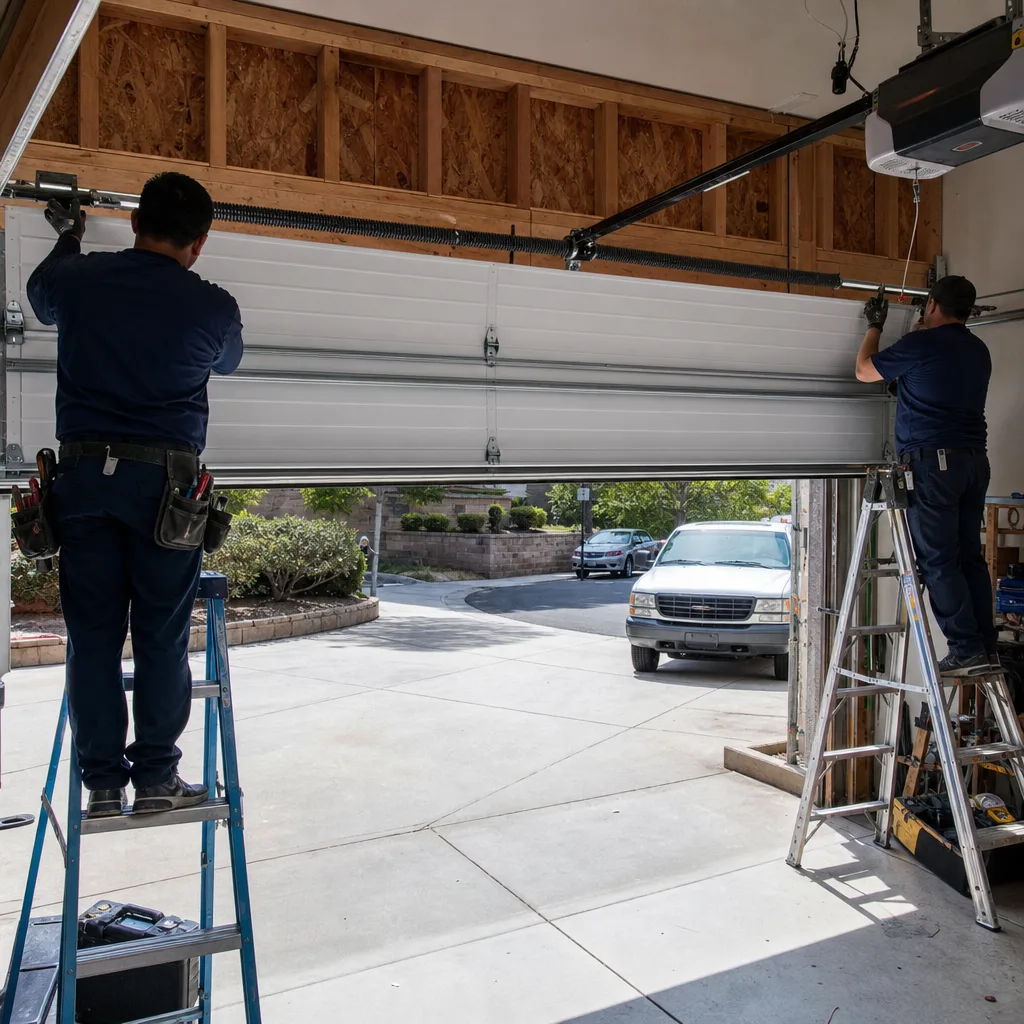
The Inland Empire’s dry heat and Santa Ana winds create a specific maintenance profile for garage doors. Coastal guides emphasize rust prevention. Here, the enemy is dry-lubricant breakdown, roller wear from wind-driven dust, and spring fatigue from sustained heat.
Follow this schedule:
- Every 3 months: Test the auto-reverse function by placing a 2×4 flat on the ground and closing the door. If the door does not reverse within 2 seconds of contact, the opener needs adjustment. This is a safety system, not a convenience feature.
- Every 6 months: Clean the tracks with a dry cloth. Do not lubricate the tracks. Lubricate the rollers, hinges, and spring with a white lithium or silicone-based garage door lubricant. In Rancho Cucamonga, Santa Ana winds deposit fine dust on horizontal surfaces; the dust mixes with wet lubricant and becomes paste. A dry-lube is better than a wet oil.
- Every 12 months: Check the door balance. Disconnect the opener and manually lift the door halfway. If it holds position, the springs are balanced. If it drops or rises, the spring tension has shifted and the door is working the opener twice as hard.
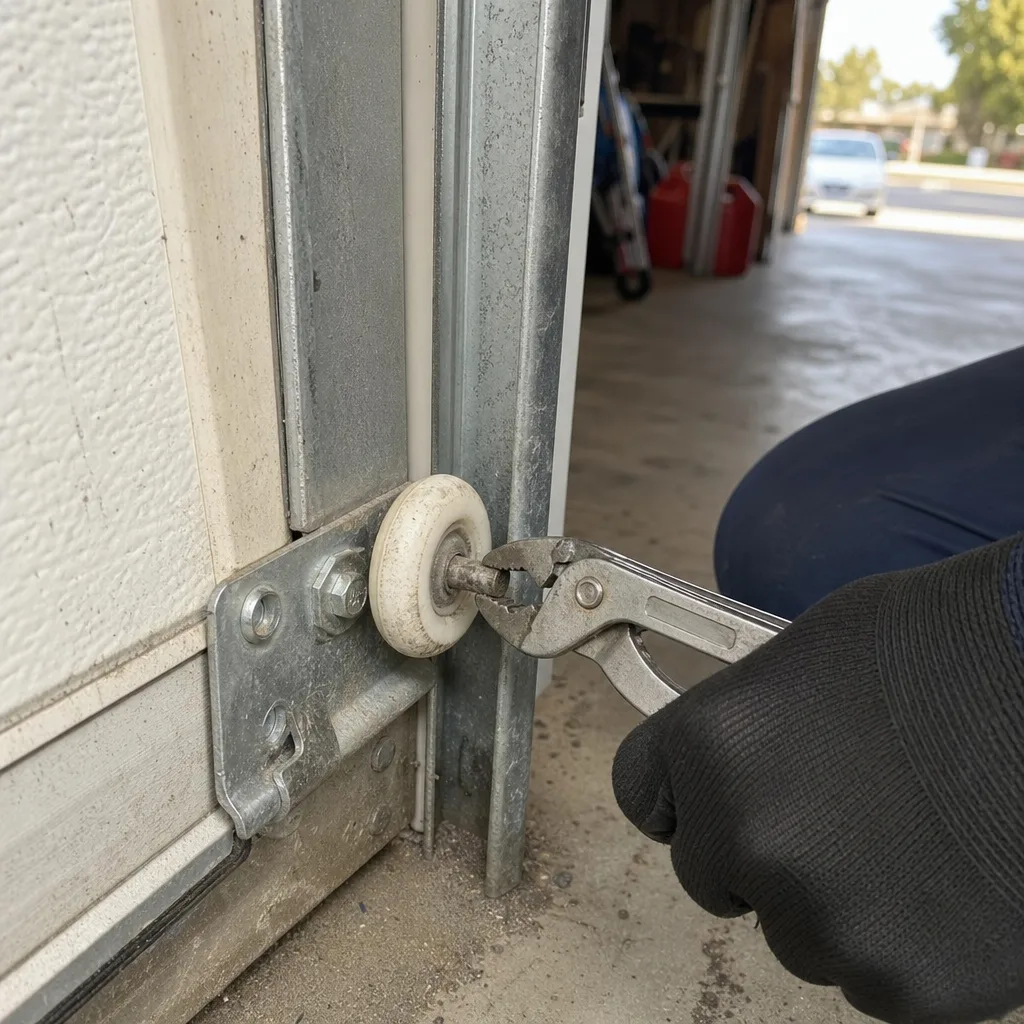
- Every 3 to 4 years: Replace nylon rollers if they show flat spots. In inland heat, nylon roller bearings dry out faster than in coastal climates.
A balanced door is audible. It opens and closes without shuddering, and the opener does not sound like it is straining. A door that has been out of balance for months will eventually burn out the opener’s motor or break a spring. The repair bill is always higher than the maintenance would have been.
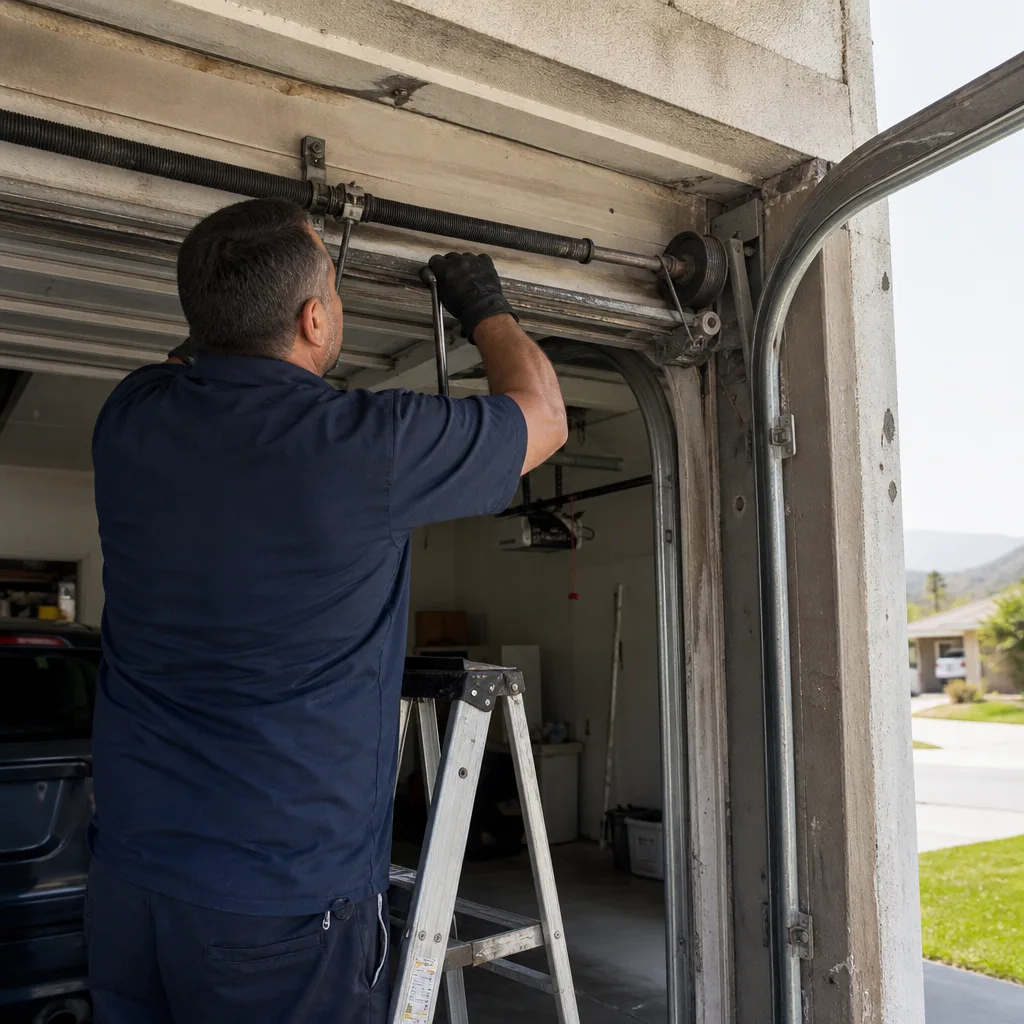
On that note: torsion spring replacement is not a maintenance task. The springs hold enough stored mechanical energy to cause serious injury if released incorrectly. A trained technician uses winding bars and a documented procedure. If a spring breaks, leave the door closed and do not attempt to manually lift it.
Choosing Between Major Brands: What Actually Matters Locally
Garage door brands in Rancho Cucamonga break into a few recognizable tiers. What we will tell you is that the brand matters less than the local parts availability and the installer’s willingness to document the job.
Chamberlain and LiftMaster are the dominant opener brands in the area. The parts are widely stocked locally, which means opener repair turnaround is fast. When a logic board or a trolley carriage fails, the part can usually be on the truck the same day. Garage Door Opener Repair & Installation in Rancho Cucamonga depends on this parts availability.
Genie makes solid openers with a slightly smaller local parts footprint. We can repair them; the subtle annoyance is that certain Genie-specific parts need to be ordered from the distributor, which adds a day in some cases.
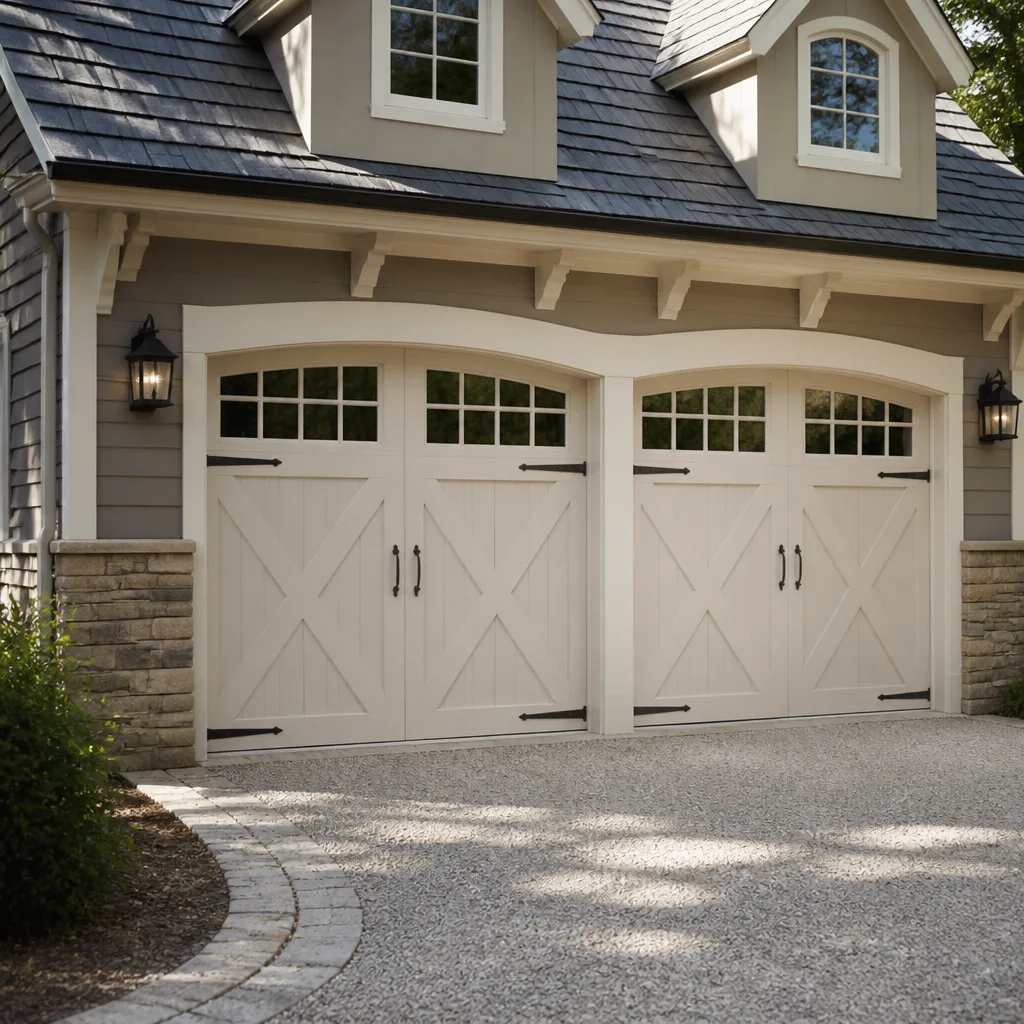
Clopay and Amarr are the two panel-door manufacturers we install most often in Rancho Cucamonga. Both offer the panel profiles that HOA architectural committees approve: raised panel, flush, and the more restrained carriage-house overlays. Both manufacturers deliver to the Inland Empire on a weekly schedule, so custom doors take about the same lead time either way.
The decision that matters more than brand is whether the door is correctly spec’d for the opening, the elevation, and the HOA. A premium Clopay door installed with an under-spec’d spring will fail before a mid-grade Amarr door installed with the correct spring. The brand is a starting point. The spec sheet is the decision.
Common Mistakes to Avoid
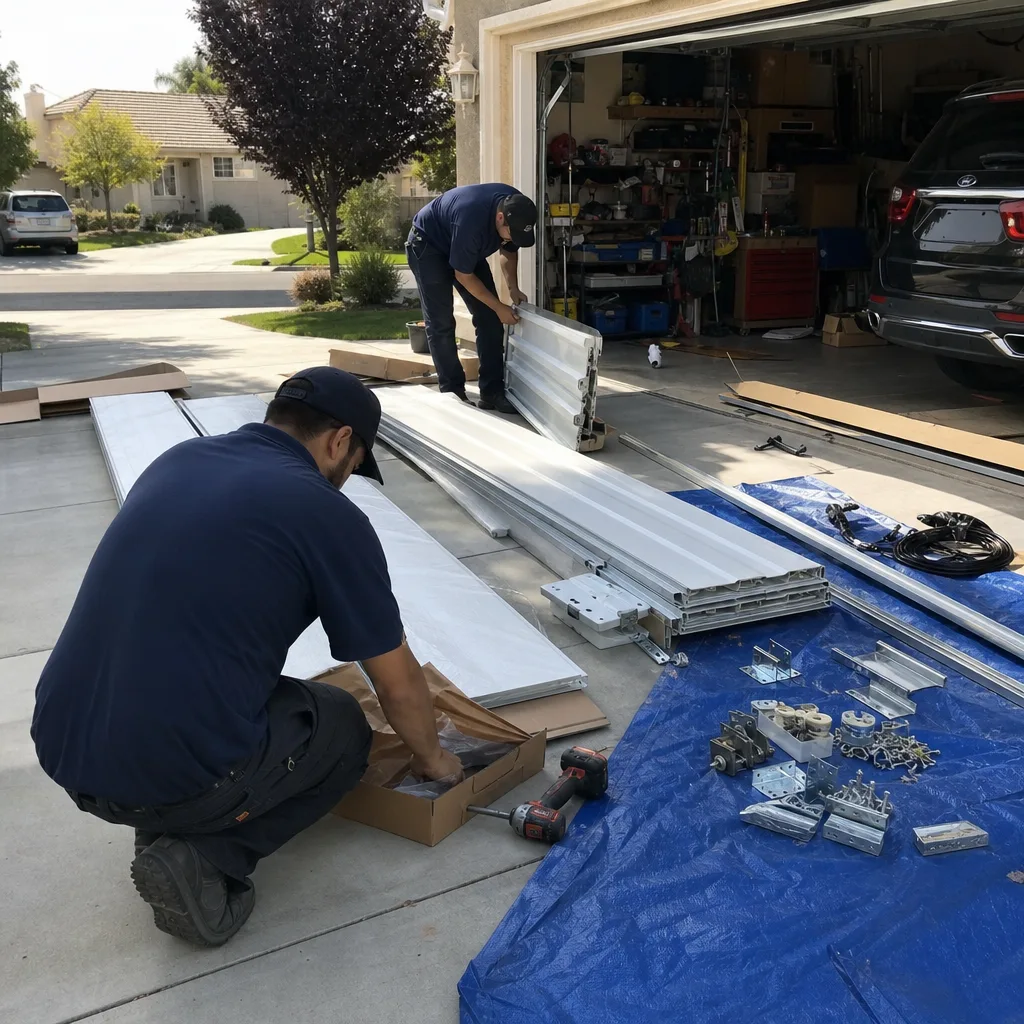
- Ordering a standard spring online without considering local heat cycles. Online spring kits are calibrated for moderate climates and will cycle out faster in a Rancho Cucamonga garage. The spring is the component that fails first.
- Installing a door without HOA architectural review. In Terra Vista, Victoria, and Etiwanda Estates, doors visible from the street require approval. Removal and reinstallation after a citation costs more than the approval process would have.
- Painting a garage door with exterior house paint. Garage doors flex and expand with heat. House paint on a sectional door cracks at the panel seams. Use a paint specified for metal doors or factory-finished panels.
- Ignoring a noisy door. A squeal or a shudder is the door telling you something is wearing out. In inland heat, the window between “noisy” and “broken” is shorter than in coastal climates.
- Replacing the opener when the door is the problem. A door that is out of balance will kill an opener. Installing a new opener on an unbalanced door means paying for the opener twice.
- Assuming a permit is needed for everything. Like-for-like replacements do not require a permit in Rancho Cucamonga. Structural opening changes do. Knowing which category your project falls into saves time and money.
When to Call a Professional
Call a professional when a torsion spring breaks, when the door comes off its tracks, when a cable frays, or when an opener’s logic board fails. These are not weekend projects, and the safety risk on spring and cable work is real. High-tension components can cause serious injury when mishandled. A trained technician has the winding bars, the process, and the documentation habit. Servo Garage Doors Rancho Cucamonga offers free estimates and a written price before any work starts. Call (909) 498-8655, and a live person answers.
Frequently Asked Questions
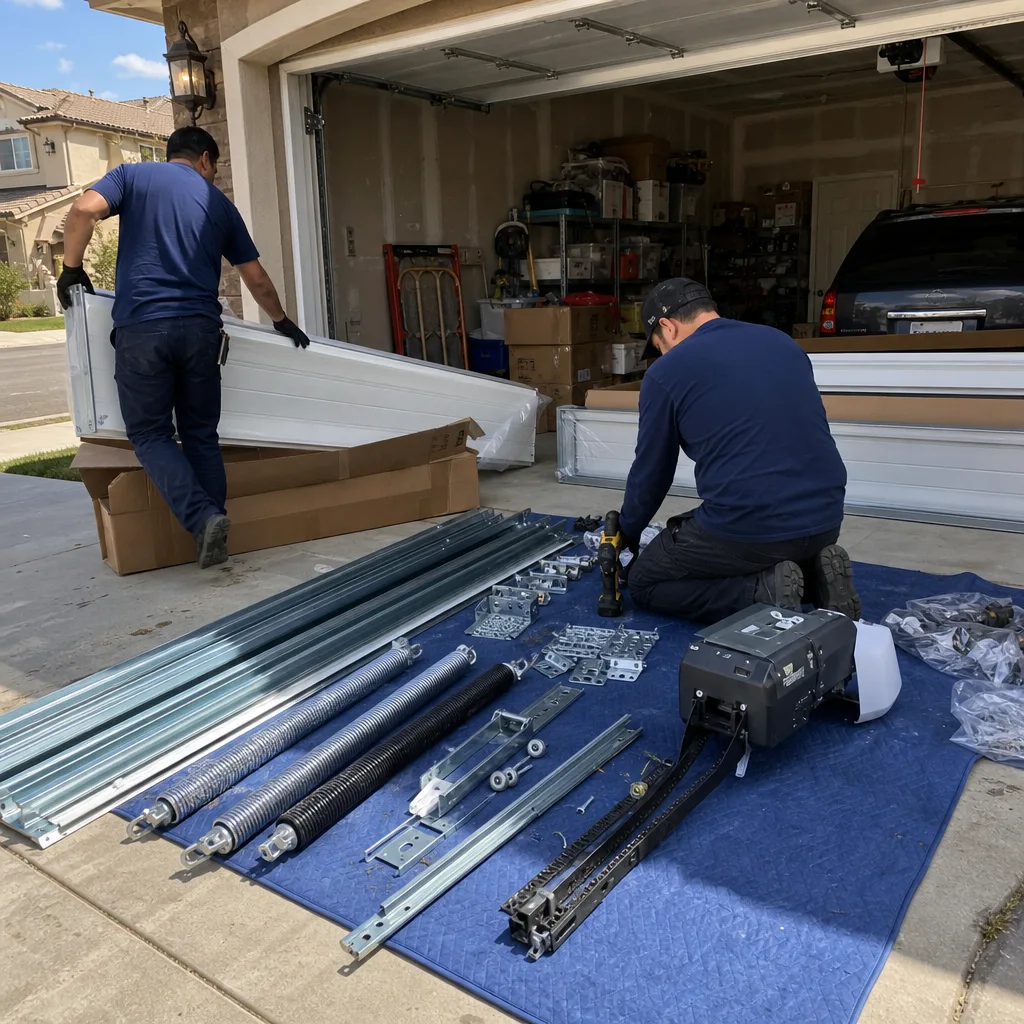
A standard single-car sectional door replacement in Rancho Cucamonga typically runs $900 to $1,700 installed, while a double door runs $1,400 to $2,600, depending on panel style, insulation, and hardware - see our Garage Door Cost Breakdown: The Rancho Cucamonga Homeowner’s Reference for 2026 for full detail. The openers are separate. Call (909) 498-8655 for a written quote based on your specific opening and HOA requirements.
We service parts and complete doors from all major manufacturers, including Chamberlain, Genie, Clopay, and Amarr, as well as LiftMaster, Wayne Dalton, Craftsman, and Raynor. Parts availability for the most common brands is good locally, which keeps repair times short.
A standard sectional door installation on an existing opening takes one day, including removal of the old door and full testing of the new one. Custom doors ordered for specific HOA architectural requirements typically add two to four weeks of lead time.
In most Rancho Cucamonga HOA communities, yes, if the door faces the street or is visible from common areas. Check your CC&Rs, find the architectural review section, and submit the manufacturer’s spec sheet before ordering. Retroactive approval is rarely granted.
No. We provide a flat, written price and written scope before any work begins. That is Clause 1 of The Haven Standard, and it applies on every job. If the scope changes, the price change is documented in writing before the additional work proceeds.
Our trucks carry the most common torsion springs, cables, roller sets, and opener parts for Chamberlain, LiftMaster, and Genie. If a specific part needs to be ordered, we tell you before scheduling the repair and document the reason. Call (909) 498-8655 and we will tell you what to expect before anyone arrives.
A torsion spring mounts on a horizontal shaft above the door and twists to lift; an extension spring stretches along the horizontal track. Modern doors in Rancho Cucamonga are overwhelmingly torsion-spring because the system is safer when tension is released and it handles the thermal load of inland summers more predictably.
The Bottom Line
A garage door in Rancho Cucamonga is a piece of local infrastructure: subject to heat cycles that shorten spring life, HOA architectural review that restricts panel choices, and municipal code provisions that most homeowners learn about too late. The decisions that matter are spring spec, panel profile, HOA submission, and R-value sized against your home’s elevation, not a national chart. If you want a company that documents every step from written quote to photo record of the completed work, Servo Garage Doors Rancho Cucamonga home page is where that paper trail starts. We are independently owned and operated under The Haven Standard, and the price is on paper before the work begins.
Written by Marcus Deller, Owner at Servo Garage Doors Rancho Cucamonga, serving Rancho Cucamonga since 2015.